


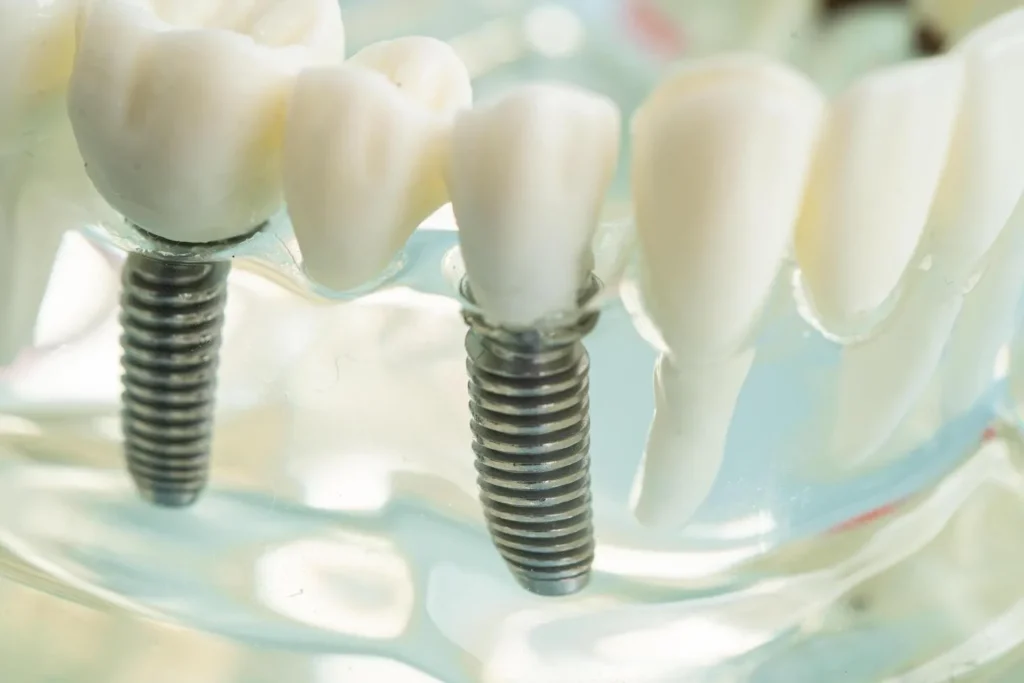
 Natural teeth set a high bar. They have living tissue, a ligament that senses pressure, and a blood supply that helps them respond to stress and infection. Dental implants, by contrast, are engineered devices. They usually include a titanium fixture in the jaw topped with a custom crown. Both can deliver strong, stable chewing, but they behave differently. Understanding those differences helps you weigh up treatment choices with your dentist.
Quick answer
Dental implants can look and function much like natural teeth, but they are not biologically identical. Implants lack the periodontal ligament that gives natural teeth fine pressure feedback, and a healthy or predictably restorable natural tooth should usually be preserved rather than removed simply to place an implant.
1.Structure and feel
A tooth is anchored by the periodontal ligament (PDL). That ligament acts like a shock absorber and gives fine tactile feedback. You can judge a stray olive pit in a bite almost instantly.
Implants don’t have a PDL. They fuse directly to bone (osseointegration), which makes them very stable, yet they offer less “sense” of pressure. Studies note this reduced proprioception compared with natural teeth, which matters when adjusting bite and protecting the restoration. Clinicians often fine-tune implant bites for precisely that reason.
Evidence also suggests that peri-implant tissues are more vulnerable to inflammation because the soft-tissue seal is different to a natural tooth’s attachment.
2.Chewing performance
When placed and restored well, implants can restore strong chewing function. Research shows implant-supported prostheses deliver markedly better bite force and masticatory efficiency than conventional full dentures, which is why implants are often recommended for denture wearers.
That said, natural dentitions still tend to register higher bite pressure than implant prostheses in direct comparisons. In practical terms, most people eat comfortably with implants. They simply have a little less fine feedback than with a natural tooth.
3.Durability and survival
Long-term data for single-tooth implant crowns are broadly reassuring, with mean survival around the mid-90% range over more than a decade in many cohorts. But “survival” isn’t the same as “never any trouble”. Biological or mechanical complications (screw loosening, porcelain chipping, or gum inflammation) do occur and sometimes require maintenance. For a broader look at treatment, risks and long-term care, our single tooth implant guide covers the full treatment pathway.
A 2026 systematic review of prospective studies estimated 93.0% implant survival after at least 20 years, although outcomes varied between studies.
Comparative reviews conclude that both implants and well-treated natural teeth can show high long-term survival; the prognosis of the individual tooth should guide the decision rather than the availability of an implant.
The take-home message: if a natural tooth is restorable and healthy enough to keep, retaining it is usually sensible. If it isn’t, an implant is a strong replacement option.
4.Disease risks: periodontitis vs peri-implantitis
Gums around teeth can develop gingivitis and periodontitis. Around implants, the parallel conditions are peri-implant mucositis and peri-implantitis.
The Australian Dental Association notes that implants don’t decay, but they can lose supporting bone if plaque-induced inflammation isn’t controlled. Peri-implantitis can loosen an implant over time.
Contemporary reviews estimate patient-level prevalence of peri-implantitis at roughly one in five, with mucositis affecting an even larger share. These figures vary by definition and study design, yet the signal is consistent: hygiene and professional maintenance matter.
A history of periodontitis, smoking and poor plaque control can increase peri-implant risk, so active gum disease should be controlled and maintenance tailored to the individual. These factors also form part of assessing dental implant candidacy, alongside bone, gum and health factors.
5.Everyday care and maintenance
Because implants lack a PDL, forces aren’t cushioned in the same way. That’s why dentists aim for meticulous bite adjustment and encourage protective habits, such as night guards for people who clench or grind.
Home care mirrors tooth care: brush twice daily with fluoride toothpaste, clean between the implant and adjacent teeth, and keep to regular professional reviews.
Surveys of dental professionals link good home hygiene with better peri-implant health, and Australian risk-management bodies emphasise structured maintenance for people with implants.

6.Aesthetics
Modern implant crowns can look remarkably natural, especially in the back of the mouth. At the front, gum shape, tissue thickness, and the position of neighbouring teeth all influence the final look.
Natural teeth can have an aesthetic advantage because enamel and dentine create complex translucency and light reflection that restorative materials must imitate. Mature enamel itself is highly mineralised and acellular, not living tissue.
An experienced implant dentist will assess smile line, gum levels, and bone support before recommending timing and techniques to optimise the result.
When keeping the tooth makes sense
If a cracked or decayed tooth can be predictably restored (say with endodontic therapy and a crown) that path preserves the natural ligament and proprioception, and avoids implant surgery.
Because extraction is irreversible, preserving a tooth with a reasonable prognosis should be discussed before implant replacement. Where replacement is necessary, comparing dental implants versus bridges and dentures can help clarify the differences between the main options.
When an implant is the better choice
Where a tooth is missing, fractured below the gum, or has hopeless periodontal support, an implant often delivers the most stable single-tooth replacement. For full dentures, implants can transform function. Even two implants to retain a lower denture can be life-changing for chewing comfort.
Options range from a single tooth implant through to full-arch concepts like All-on-4 for people with advanced tooth loss.
Once an implant has been recommended, the single tooth implant timeline explains what happens from assessment and placement through healing and the final crown.

Key differences at a glance
| Aspect | Natural teeth | Dental implants |
| Structure & sensation | Root suspended by a periodontal ligament (PDL) that cushions load and provides fine tactile feedback. | Fixture fuses directly to bone (osseointegration) with no PDL. Very stable but less fine touch. |
| Chewing performance | High bite force and natural feedback in intact dentitions. | Restores strong function; implant-retained overdentures outperform conventional dentures for chewing efficiency and comfort. |
| Decay vs disease | Teeth can decay and develop gingivitis/periodontitis. | Implants don’t decay, but tissues can develop mucositis or peri-implantitis. |
| Longevity (survival) | Healthy, well-treated teeth often last decades. | 10-year implant survival typically ~93–96% |
| Maintenance | Standard home care plus interdental cleaning. Periodontal reviews if you have gum history. | Same routine, with extra attention at the implant–gum junction. Night guard may be recommended if you clench/grind. |
| Best use case | Keep a restorable tooth to preserve natural sensation and biology. | Replace missing or non-restorable teeth, especially valuable to stabilise full dentures. |
Frequently asked questions
Do dental implants feel exactly like natural teeth?
Not exactly. They can feel very natural in use, but the lack of a periodontal ligament means fine pressure feedback is different.
Can a dental implant get a cavity?
No. Implant components do not decay like enamel and dentine, but plaque can still inflame the surrounding gum and bone.
Can gum disease affect a dental implant?
Yes. Peri-implant mucositis and peri-implantitis can affect the tissues around implants, especially when risk factors are not well controlled.
Is it better to save a natural tooth or replace it with an implant?
If a tooth can be predictably restored and maintained, preserving it is usually the first option to discuss. Implants are most relevant for missing or non-restorable teeth.
Can natural teeth move next to an implant over time?
Yes. Natural teeth can shift slightly while an osseointegrated implant is comparatively fixed, so contact points and alignment can change over time.
Final word
Natural teeth, when saveable, are worth the effort. When they can’t be saved, implants provide a strong, well-researched replacement that restores function and confidence, so long as you commit to healthy gums, careful bite management, and ongoing reviews. If you’re weighing options or timing, speak with a clinician who can assess bone, gum health, and bite forces in detail, and map out the plan that suits your mouth and your goals.
If treatment is likely to go ahead, you will have to assess the dental implant costs in Sydney, which depends on multiple factors such as age, jawbone health, and more. Talk to a dentist to get an estimate.