


Losing one tooth can seem manageable at first. Many people cope by chewing on the other side, smiling with their lips closed, or putting treatment off until the gap starts to bother them more. The trouble is that a single missing tooth can affect more than appearance. It may alter bite balance, reduce chewing efficiency, and leave the surrounding area more difficult to clean.
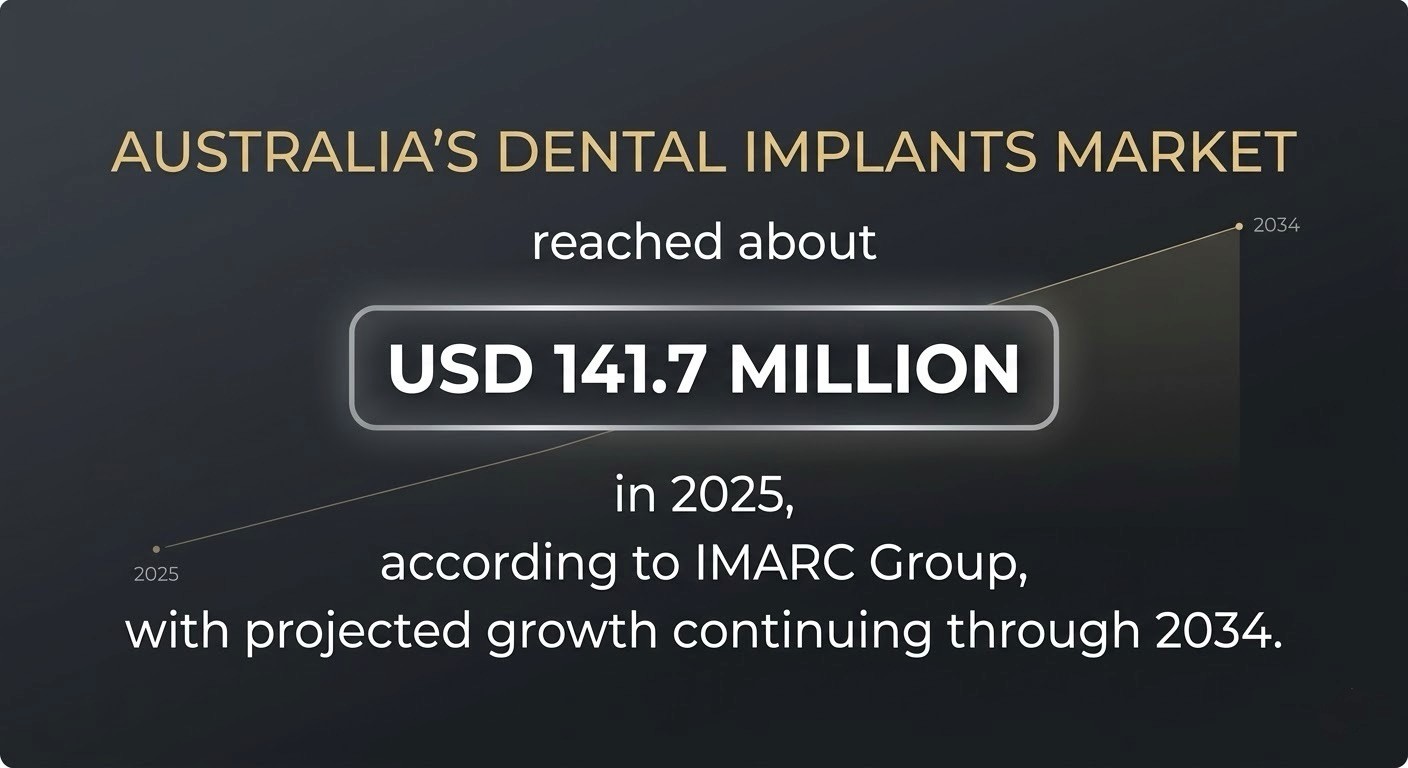
According to Healthdirect Australia, a dental implant is a metal screw that replaces the root of a missing tooth and supports a crown, bridge or denture. It is often chosen because it feels stable and usually does not involve cutting down neighbouring teeth. In fact, Australia’s dental implants market reached about USD 141.7 million in 2025, according to IMARC Group, with projected growth continuing through 2034.
Key Takeaways
- A single tooth implant replaces one missing tooth with a fixed option that looks and feels close to a natural tooth.
- Replacing one missing tooth can help maintain chewing function, bite balance, speech, and appearance.
- Good candidates often have healthy gums, enough bone support, and general health that allows normal healing.
- Some patients may need extra steps such as bone grafting before or during implant treatment.
- The full treatment process often takes several months because healing and crown placement happen in stages.
- In Sydney, single tooth implant costs in 2026 can vary depending on scans, grafting, sedation, materials, and case complexity.
- Long-term success depends on careful planning, good oral hygiene, bite management, and regular maintenance.
What is a single tooth implant?
A single dental implant replaces one missing tooth with three main components:
- The implant fixture placed into the jawbone
- The abutment that connects the parts
- The custom-made crown that sits above the gum line
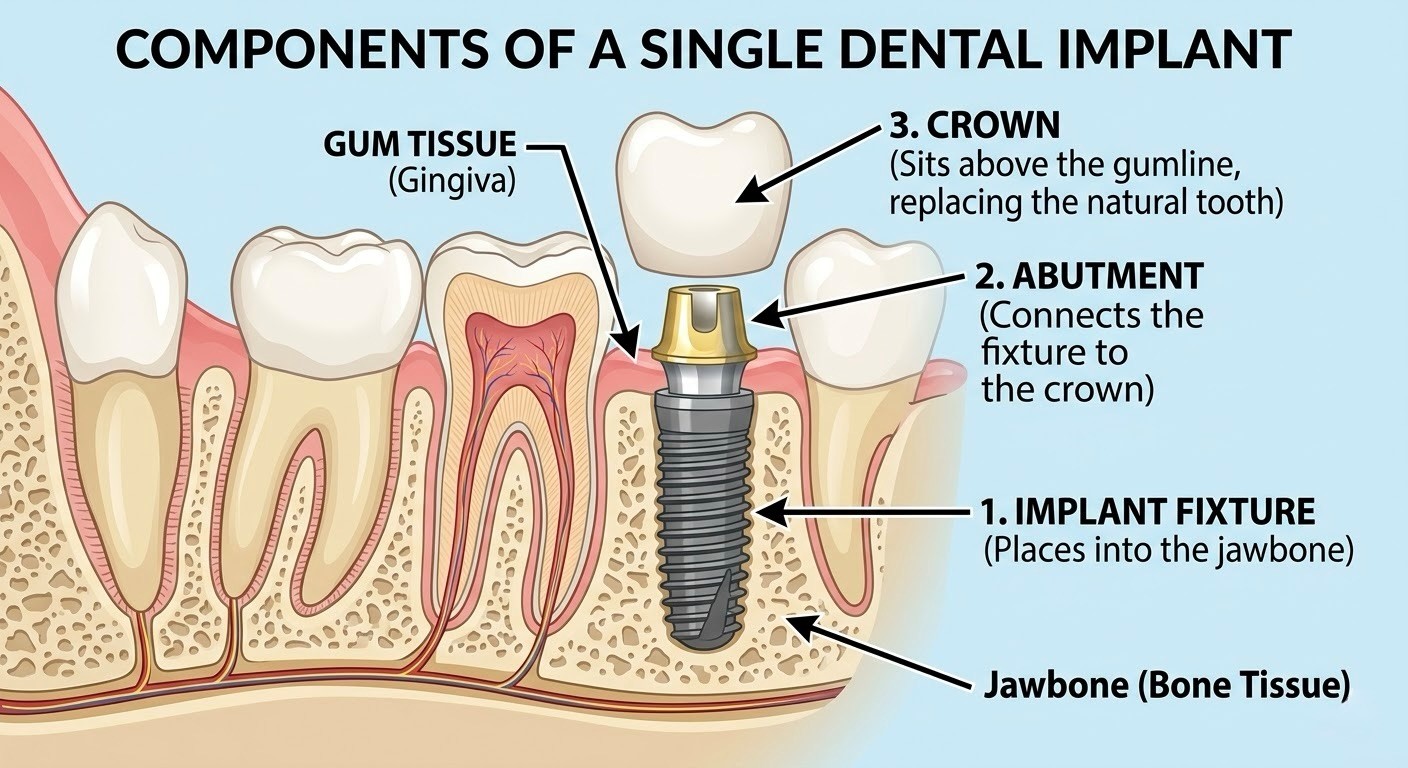
The implant sits where the natural root once was, while the crown is designed to look like a real tooth. The point of the treatment is not only to fill a gap. It is to provide a fixed replacement supported by bone, rather than by adjacent teeth alone.
In practical terms, that means an implant may suit someone who wants:
- a fixed tooth rather than a removable appliance
- a replacement for one missing tooth
- an option that often leaves neighbouring teeth untouched
A conventional bridge can still be a sound treatment in the right case, but it may require reshaping the teeth next door to support the replacement. An implant usually avoids that.
Why replacing one missing tooth matters
A gap is not always urgent in the dramatic sense, though it is rarely neutral. Over time, several changes can occur:
- Nearby teeth may drift into the space
- The opposing tooth may over-erupt
- Chewing can become less efficient
- Speech may be affected if the tooth is near the front
- Bone in the area may shrink after tooth loss
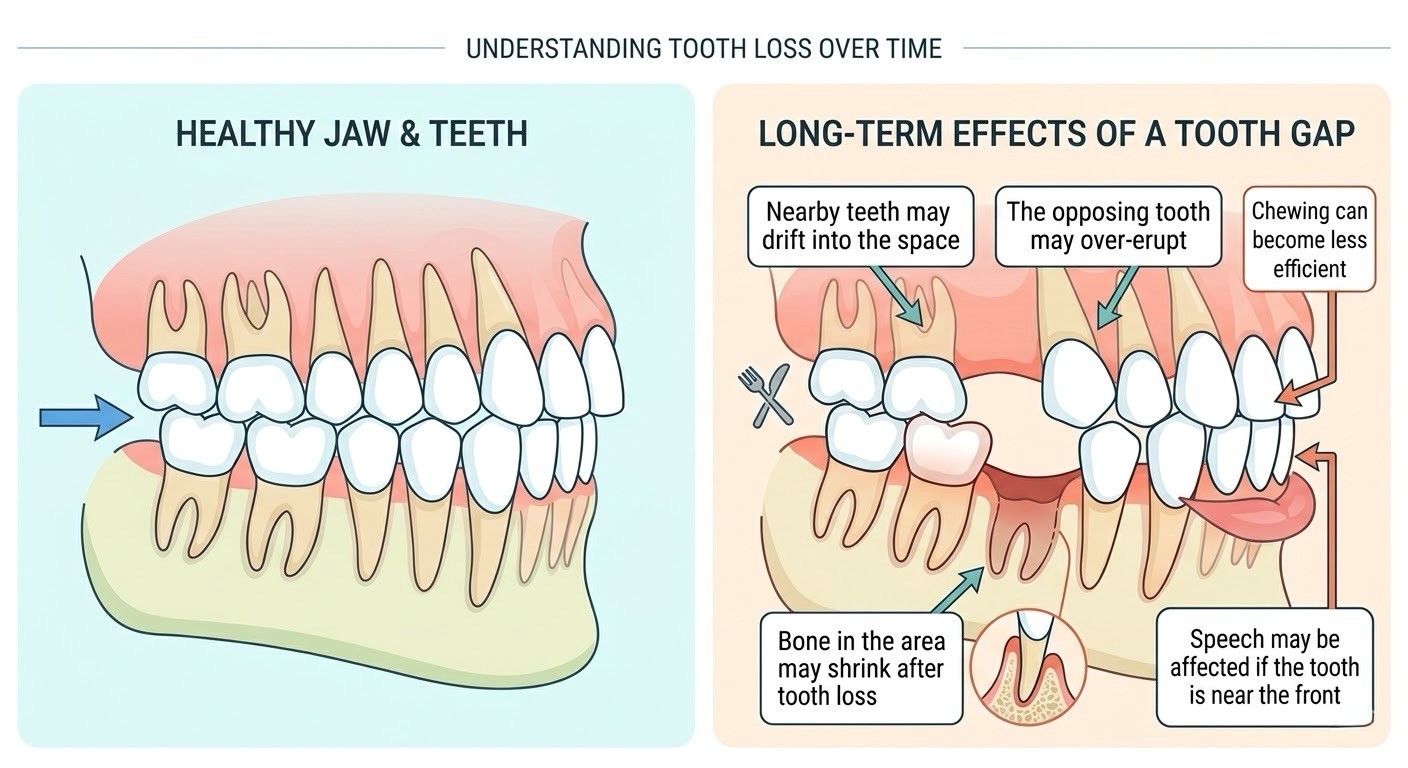
Bone loss is a key point that patients often do not hear early enough. Once a tooth root is gone, the bone in that site is no longer stimulated in the same way. That does not mean every gap immediately turns into a complex surgical case, but delay can reduce options or add steps later on.
For front teeth, people usually notice the cosmetic and speech side first. For back teeth, the issue is often function. Food packs into the space, chewing becomes awkward, and the bite can start to feel uneven. That is why dental implants are often the first choice when it comes to missing tooth replacement. They deliver long-term stability, not just appearance.
Who is usually a good candidate?
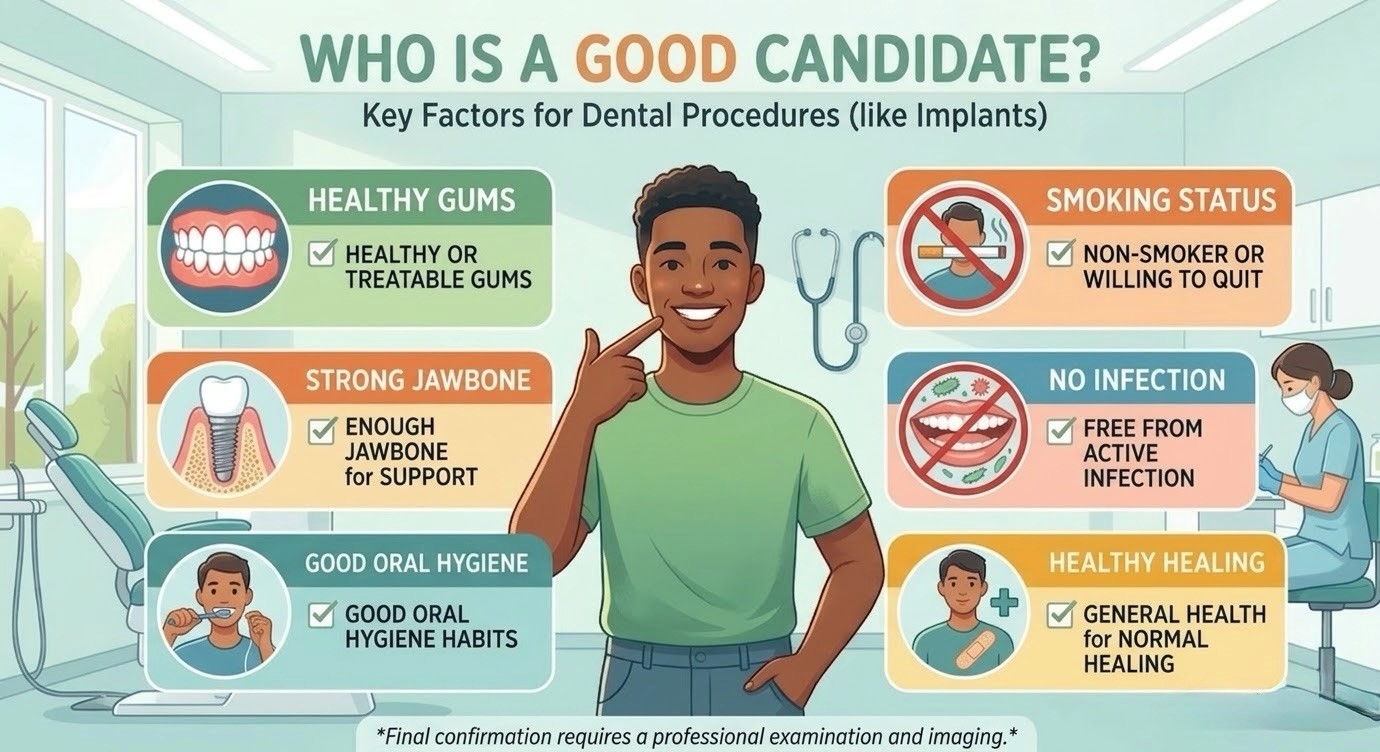
A dentist can only confirm suitability after examination and imaging, but the broad features of a good candidate are fairly consistent. Many suitable patients have:
- Healthy or treatable gums
- Enough jawbone for implant support
- Good oral hygiene habits
- A mouth free from active infection
- General health that allows normal healing
Some of these factors do not rule implant treatment out, though they can change the plan:
- Past gum disease
- Smoking
- Diabetes that is not well controlled
- Heavy clenching or grinding
- Low bone volume at the site
Low bone density is especially common where a tooth has been missing for some time. In those cases, grafting may be advised before implant placement or at the same time. Bone grafting is often used when there is not enough bone to support an implant properly.
A sensible consultation should not rush this part. It should cover:
- Your dental history
- The reason the tooth was lost
- The condition of the gums and surrounding teeth
- Bite forces
- Imaging, often including 3D scans where needed
- Whether alternatives may suit you better
If you are wondering what really determines your candidacy for dental implants, this guide should help.
“Dental implants deliver long-term stability, not just appearance”
Single implant versus other replacement options
A single implant is not the only way to replace one tooth. The main alternatives are a bridge and a removable partial denture. Each has a place.
1. Single implant
Often chosen when the goal is a fixed, standalone replacement.
Common strengths:
- Does not usually rely on adjacent teeth
- Stable feel when healed
- Can look very natural
- Supports a crown in a way that mimics a tooth root
Points worth noting:
- Higher upfront cost
- Requires surgery
- May involve grafting or staged treatment
2. Dental bridge
Often chosen when surgery is not ideal or when a quicker fixed solution is preferred.
Common strengths:
- Fixed option
- Shorter overall treatment time in many cases
- No implant surgery
Points worth noting:
- May require preparation of neighbouring teeth
- Long-term maintenance depends partly on the supporting teeth
Dental Bridge vs. Single Tooth Implant: Learn Why Dental Implants Are the Long-Term Winner
3. Partial denture
Often chosen when budget is the main concern or when a temporary solution is needed.
Common strengths:
- Lower Initial Cost
- Non-surgical
- Can Replace one or more teeth
Points worth noting:
- Removable
- May feel less natural
- Can affect comfort and confidence for some people
There is no universal “best” option. The better question is which option fits the condition of the mouth, the patient’s priorities, and the likely long-term maintenance burden.
| Replacement option | What it involves | Why patients choose it | Things to keep in mind |
| Single implant | A titanium implant is placed in the jawbone and topped with a crown | Good for patients who want a fixed, natural-looking replacement that usually does not affect neighbouring teeth | Costs more upfront, involves surgery, and may need grafting or staged treatment |
| Dental bridge | A replacement tooth is supported by the teeth on either side of the gap | A fixed option that can often be completed faster than an implant and does not involve implant surgery | The teeth next to the gap may need to be prepared, and the result depends partly on those supporting teeth |
| Partial denture | A removable appliance replaces the missing tooth | Often chosen when keeping costs down is the priority or when a temporary solution is needed | It is removable, may feel less natural, and some people find it less comfortable or less confidence-inspiring |
The single tooth implant process step by step
The process is usually more orderly than people expect. It is not always fast, but it is usually straightforward when the site is suitable.
1. Consultation and planning
This stage often includes:
- Clinical examination
- X-rays or 3D imaging
- Discussion of options
- Treatment sequencing
- Quote and consent process
2. Extraction, if the tooth is still present
If the damaged tooth cannot be saved, it may need to be removed first. In some cases the implant can be placed at the same appointment. In others, healing is allowed before the next stage.
3. Implant placement
The implant fixture is placed into the jawbone under local anaesthetic. Some clinics also offer sedation for suitable patients.
4. Healing and osseointegration
This is the stage people often underestimate. Cleveland Clinic states that initial healing may take about a week, but the jawbone generally takes around three to nine months to fuse with the implant in a process known as osseointegration.
5. Final crown
Once the implant is stable, the abutment and crown are fitted. The final crown is shaped and shaded to match the neighbouring teeth as closely as possible.
6. Review and maintenance
Checks after treatment are part of good care, not an optional extra. Bite, gum response and cleaning access all matter.
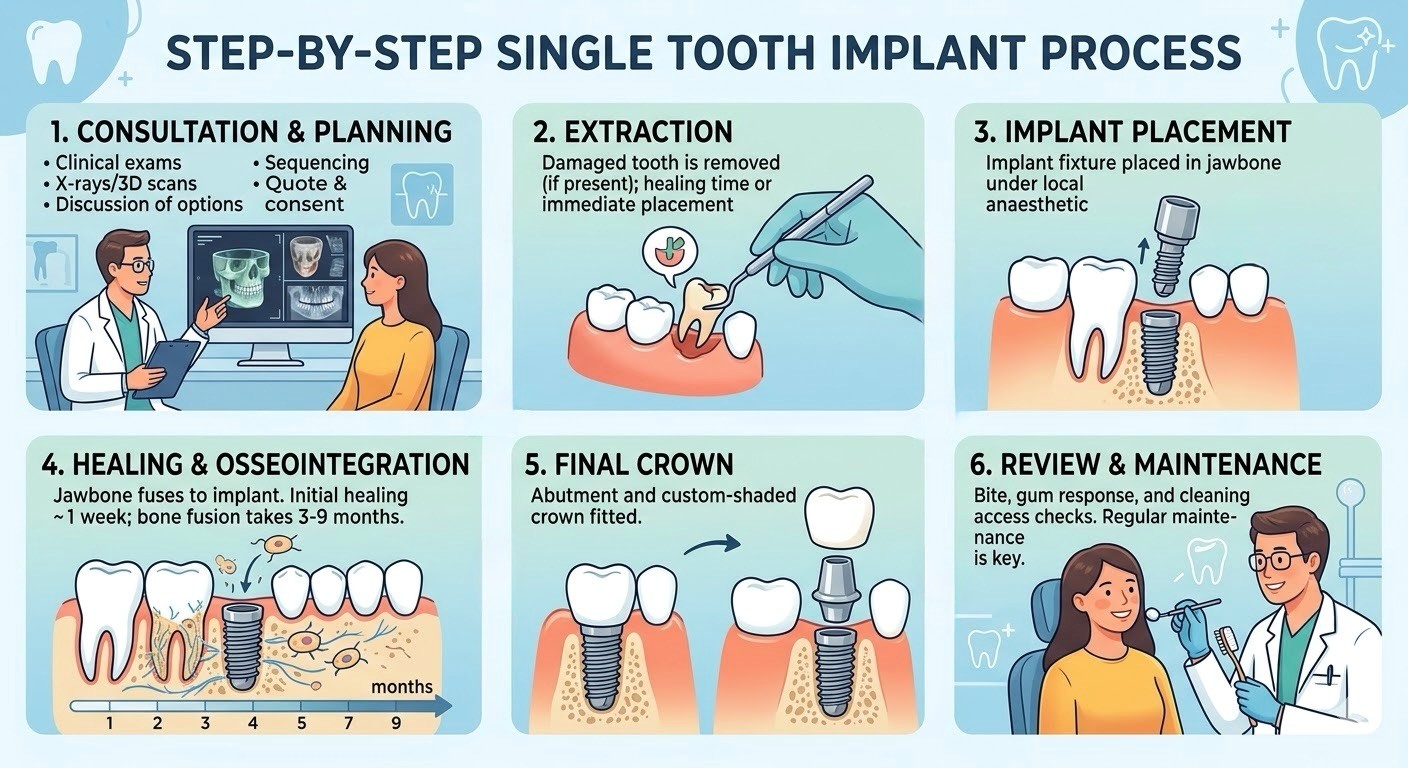
This guide tells you in detail what to expect at each stage of the dental implant process
Same-day implants: Possible, but not for everyone
Same-day dental implants get a lot of attention in the recent times. It sounds tidy and efficient, and sometimes it is. In clinical terms, it usually refers to immediate implant placement after extraction, sometimes with a temporary crown or temporary tooth fitted on the same day.
That does not mean every patient can walk in with a failing tooth and leave with a permanent final result a few hours later. Immediate protocols depend on careful case selection. PMC has reported strong results in appropriate cases, though they also stress the need for stability at placement and suitable bone and bite conditions.
A patient may be more likely to suit same-day treatment if they have:
- Enough healthy bone
- Limited infection at the site
- Good gum conditions
- Favourable bite forces
- A tooth position that allows predictable temporary restoration
A patient may be less likely to suit it if there is:
- Active infection
- Not enough primary stability
- A need for major grafting
- Difficult aesthetic demands at the front
- Heavy grinding or unstable bite
That distinction matters because oversimplified marketing can create unrealistic expectations. Same-day treatment is real. It is simply not the right plan for every mouth.
Cost in Sydney in 2026: What affects the dental implant fee
The most honest answer on cost is that there is no single standard fee in Australia. Healthdirect notes that dental costs vary widely because clinics set their own fees.
Current 2026 pricing trends commonly place implant treatment somewhere in the broad range of about $2,500 to $7,000. The total price counts bone grafting, sedation, complex crown work and other factors.
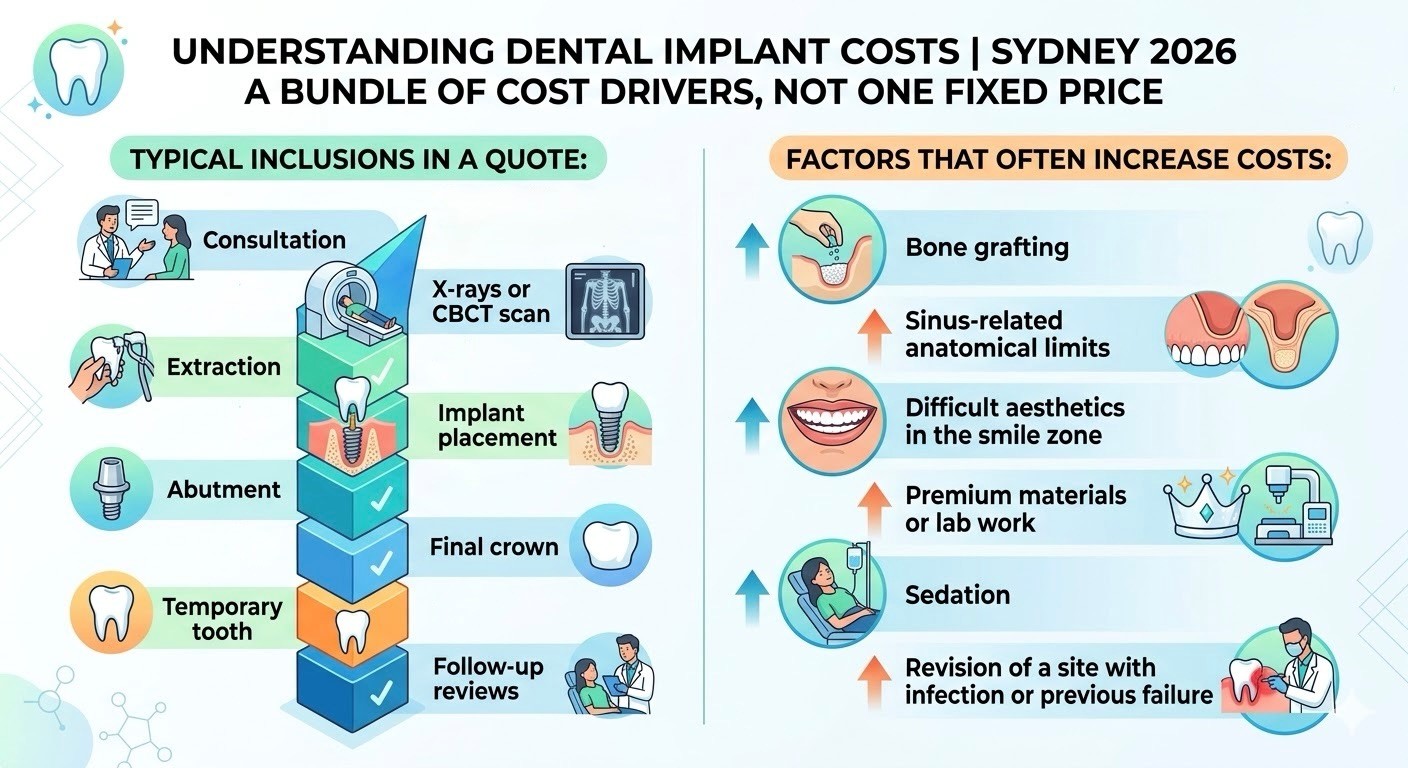
That means, the dental implant cost in Sydney for 2026 is better understood as a bundle of cost drivers, not one fixed price.
A quote may include:
- Consultation
- X-rays or CBCT scan
- Extraction
- Implant placement
- Abutment
- Final crown
- Temporary tooth
- Follow-up reviews
Costs of dental implants often rise when the case involves:
- Bone grafting
- Sinus-related anatomical limits in upper sites
- Difficult aesthetics in the smile zone
- Premium materials or lab work
- Sedation
- Revision of a site with infection or previous failure
A useful question for patients is not “What is your implant price?” but:
- What exactly is included?
- Is the crown included?
- Are scans included?
- Is grafting likely?
- Is a temporary tooth part of the quote?
- What happens if the site needs additional treatment?
That tends to produce clearer answers and fewer surprises.
We deep dive on the single tooth implant cost in Sydney, where we talk about fees, insurance, and gap payments in 2026. Check it out.
Recovery, pain and realistic expectations
One of the most common concerns is pain. Most people are relieved to find that implant placement is usually performed under local anaesthetic, so the procedure itself is generally manageable. Discomfort is more relevant after the numbness wears off.
Typical short-term recovery may include:
- Mild to moderate soreness
- Swelling
- Tenderness when chewing
- A need for softer foods for a few days
- Temporary instructions on cleaning around the site
Some possible complications include infection, damage to nearby structures, nerve symptoms and sinus problems in upper-jaw cases. These risks are not common in straightforward treatment, though they are real and should be discussed openly.
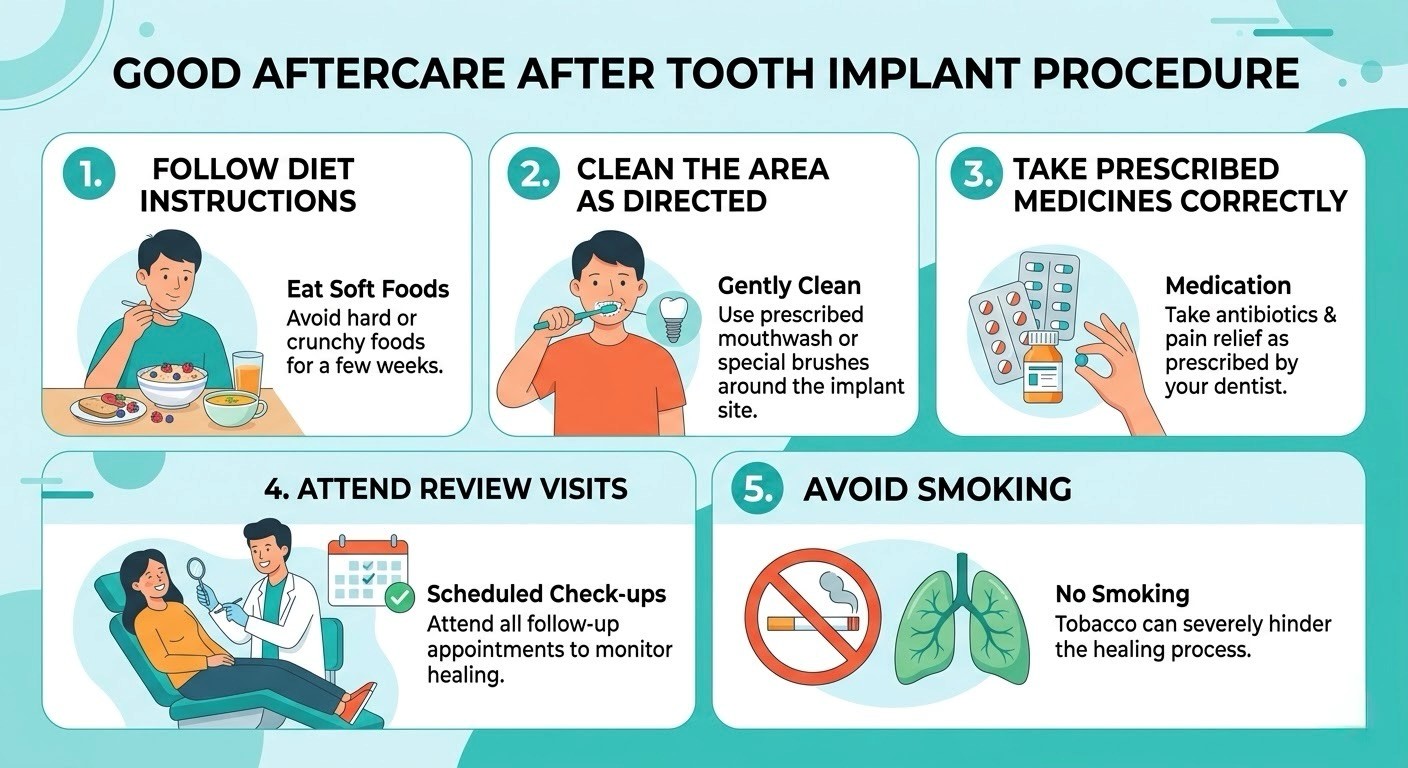
Good aftercare usually includes:
- Following diet instructions
- Cleaning the area as directed
- Taking prescribed medicines correctly
- Attending review visits
- Avoiding smoking where possible
Risks, success and the role of guided systems
Implants have high success rates overall, but success is not just about the implant “staying in.” It also includes gum health, bite comfort, cleaning access and the appearance of the final crown.
Several things influence outcomes:
- Sound diagnosis
- Enough bone and stable placement
- Gum health
- Smoking and general health factors
- Bite control
- Maintenance over time
Some clinics now use guided or AI-assisted planning systems. These systems use digital imaging and planning software to map implant position more precisely. Computer-assisted implant surgery can improve placement accuracy compared with unguided approaches, which may help with planning around anatomy and prosthetic design.
That said, better accuracy does not justify a blanket promise that AI-guided treatment is always “safer” in every case. The clinician’s judgment, the quality of the plan, and the patient’s biology still shape the result.
Check out this detailed aftercare guide to make your dental implants last a lifetime
Choosing the right provider in Sydney
A good implant consultation should feel clear, not theatrical. Patients are usually better served by a clinician who explains limits as carefully as benefits.
Look for:
- a full examination and imaging process
- clear explanation of alternatives
- written quotes with inclusions and exclusions
- discussion of risks and likely timeline
- a maintenance plan after treatment
Be cautious if you hear:
- pressure to commit on the day
- vague pricing
- no discussion of bridge or denture alternatives
- promises that every case can be done immediately
- broad claims with little reference to your actual mouth
Frequently Asked Questions:
- How much does a single tooth implant cost in Sydney in 2026?
A straightforward single implant in Australia commonly falls around $2,500 to $7,000, though Sydney pricing can be higher once scans, grafting, sedation, temporary teeth or specialist care are involved. The main thing is to check what is included in the written quote.
- What is the recovery time for a single tooth implant?
Early recovery is often about a few days to one week, though the deeper healing phase is longer. Cleveland Clinic notes that bone integration usually takes about three to nine months before the final restoration stage is complete.
- Are AI-guided dental implants safer than traditional methods?
Guided systems can improve planning accuracy and placement precision, which may reduce certain errors. Still, “safer” is too broad to promise across all cases. Technique, case selection and the clinician’s experience remain central.
- How long does the single tooth implant procedure take?
The placement appointment itself is usually done in one visit. The full treatment journey often takes several months because planning, healing and crown fitting happen in stages.
- Can I get dental implants in Sydney if I have low bone density?
Possibly, yes. Low bone density does not always rule treatment out. Some patients need bone grafting or a staged plan first so the site can support the implant more reliably.
- Is a single implant better than a bridge?
It can be, especially when preserving the neighbouring teeth is a priority. A bridge may still be the better choice in some mouths, particularly where surgery is not suitable or a faster fixed option is preferred.
- How long can a single tooth implant last?
There is no honest lifetime guarantee. With good placement, strong home care and regular dental maintenance, implants can last many years. Long-term outcome depends on gums, bite forces, smoking, general health and cleaning around the implant.
Missing a tooth? Tooth Implant Sydney offers affordable implant care with over 3,500 dental implants placed, free consultations, no hidden costs, and Australian-made crowns. Book your appointment today to discuss your options, get a clear treatment plan, and take the next step toward a confident, natural-looking smile right here today.